The Corner Chemist Who Knew Your Grandmother's Recipe: When Medicine Was Still Made by Hand
When Your Pharmacist Was Your Health Confidant
Walk into any pharmacy today, and you'll likely encounter a bustling operation: rows of orange prescription bottles, automated dispensing systems, and a pharmacist buried behind a computer screen who might glance up long enough to ask for your date of birth. It's efficient, certainly, but it's also a far cry from the intimate world of American pharmacy that existed just a few decades ago.
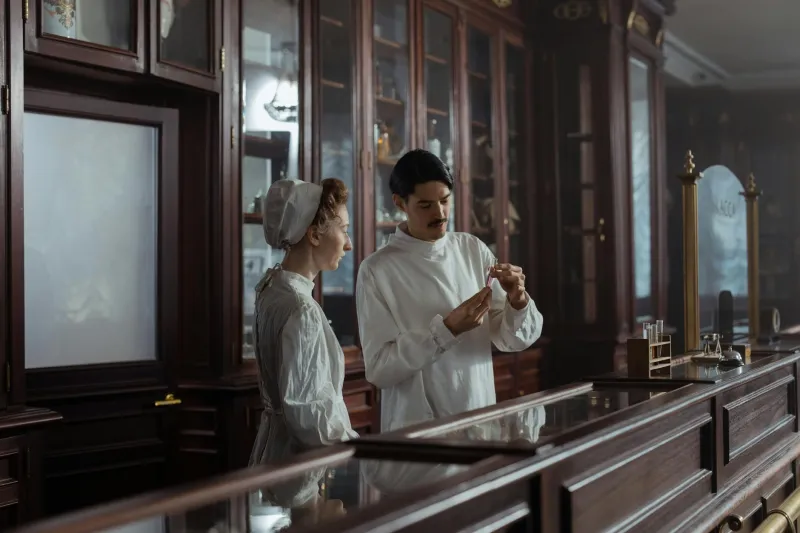
In the 1940s and 1950s, your neighborhood pharmacist didn't just count pills—he made them. Behind that polished wooden counter sat a mortar and pestle, scales precise to the milligram, and shelves lined with raw ingredients that would be transformed into the exact medicine your doctor ordered. This wasn't mass production; it was custom craftsmanship, one prescription at a time.
The Art of Compounding
Pharmacist Robert Chen's grandfather owned a drugstore in Chicago's Chinatown from 1938 to 1982. "My grandfather knew the weight and health concerns of every regular customer," Chen recalls. "Mrs. O'Brien needed her heart medication mixed with a touch of peppermint because the regular formula upset her stomach. The Murphy boy got his asthma powder in capsules instead of loose because he'd refuse to take it otherwise."
This level of customization wasn't unusual—it was standard practice. Pharmacists spent years learning not just the science of drug interactions, but the art of compounding: mixing powders, creating custom-strength solutions, and even flavoring medicines to make them more palatable. Every prescription was essentially a small manufacturing process.
The typical neighborhood pharmacy carried maybe 200 different raw ingredients. Today's chain pharmacy stocks over 3,000 pre-manufactured drugs, but the pharmacist rarely touches the actual medicine. Instead of grinding roots or measuring powders, they're scanning barcodes and managing insurance claims.
More Than Medicine
The old-school pharmacy served as an unofficial community health center. Pharmacists diagnosed minor ailments, recommended treatments for everything from insomnia to indigestion, and often served as the first line of medical advice for families who couldn't afford frequent doctor visits.
"People would come in and describe their symptoms," remembers Dorothy Williams, whose family ran Williams Pharmacy in rural Alabama for forty years. "We'd listen, ask questions, and often suggest remedies. Sometimes we'd tell them they needed to see a doctor, but many times we could help right there."
This wasn't just about convenience—it was about relationship. Your pharmacist knew that your mother was diabetic, that your father had back problems from his job at the mill, and that your youngest daughter was allergic to penicillin. This knowledge lived in their memory, not in a computer database that could be accessed by any of dozens of rotating staff members.
The Chain Revolution
The transformation began in the 1960s when pharmaceutical companies started mass-producing standardized medications. Why spend twenty minutes mixing a custom compound when you could dispense a pre-made pill in thirty seconds? The economics were undeniable: chain pharmacies could serve more customers, faster, and cheaper.
By the 1980s, the corner pharmacy was becoming an endangered species. Walgreens, which had 9 stores in 1901, exploded to over 1,000 locations by 1975. CVS, founded in 1963, grew from a single store to a nationwide chain in just two decades. These weren't just pharmacies—they were retail operations that happened to fill prescriptions.
What We Gained and Lost
Today's pharmacy system offers undeniable advantages. Medications are safer, more consistent, and often more effective than their hand-mixed predecessors. You can fill a prescription at virtually any pharmacy in America, and computerized systems catch dangerous drug interactions that even the most experienced pharmacist might miss.
But something intangible disappeared in the transition. The relationship between pharmacist and patient became transactional rather than personal. The deep knowledge of individual health histories gave way to brief consultations and printed warning labels.
"I remember when Mr. Patterson, our pharmacist, called my mother to check on my father's blood pressure medication," says Chicago resident Maria Santos. "He'd noticed Dad hadn't picked up his refill on time. Try getting that kind of attention at a CVS."
The Craft That Refuses to Die
Interestingly, compounding pharmacy is making a modest comeback. Specialized pharmacies now serve patients who need custom medications—children who require liquid versions of adult pills, patients allergic to common fillers, or those needing hormone therapies mixed to specific strengths.
These modern compounding pharmacies blend old-world craftsmanship with contemporary safety standards. They're regulated more strictly than their predecessors, with detailed documentation and quality testing that would have amazed pharmacists from the 1950s.
The Price of Progress
The evolution from corner chemist to chain pharmacy represents a classic American trade-off: we gained efficiency, consistency, and affordability, but lost intimacy, craftsmanship, and personalized care. Whether this was worth it depends largely on what you value more—the convenience of picking up a prescription at midnight from any of thousands of locations, or the comfort of a pharmacist who remembered your name and your grandmother's remedy for chest congestion.
In an age where artificial intelligence is beginning to assist with prescription management and robots fill pill bottles, the era of the neighborhood pharmacist who knew your family's medical history feels not just distant, but almost quaint. Yet for those who experienced it, that personal touch represented something irreplaceable—a time when your health care provider was also your neighbor, and medicine was still, quite literally, a hands-on profession.