When Learning Meant Listening and Repeating
Walk into a typical American classroom in 1955, and you'd hear something that might sound like a military drill. Thirty-five students sitting in perfectly aligned wooden desks, backs straight, eyes forward, reciting the same multiplication tables in unison. "Seven times eight is fifty-six. Seven times nine is sixty-three." The teacher, usually a stern woman in a conservative dress, would pace the front of the room with a wooden pointer, ready to correct any student who dared to stumble.
This was education in mid-century America: a factory model designed to produce citizens who could follow instructions, recall information on command, and respect authority without question. The curriculum was standardized across the nation, delivered through thick textbooks that students were expected to memorize chapter by chapter. History meant dates and names. Math meant formulas and procedures. English meant grammar rules and spelling lists.
Students raised their hands to speak, stood when an adult entered the room, and addressed their teacher as "Yes, ma'am" or "No, sir." The classroom was a temple of quiet concentration where the only acceptable noise was the scratch of pencils on paper or the collective recitation of the day's lesson.
The Discipline of Silence
Discipline wasn't just encouraged in these classrooms—it was the foundation of learning itself. Students who talked out of turn faced public humiliation, extra homework, or a trip to the principal's office where corporal punishment was still legal and common. The message was clear: knowledge flowed in one direction, from teacher to student, and questioning that flow was a sign of disrespect, not curiosity.
Recess was structured, lunch was supervised, and even bathroom breaks required permission. Students learned to raise their hand and wait to be called upon before speaking. The smart kids weren't necessarily the ones who thought creatively—they were the ones who could repeat back exactly what they'd been taught, word for word, without deviation or interpretation.
This system worked for an America that needed workers who could follow precise instructions in factories, soldiers who could execute orders without hesitation, and citizens who trusted institutions to make decisions for them. But it was also a system that inadvertently taught millions of children that their own thoughts and questions were less valuable than memorized answers.
The Collaborative Classroom Revolution
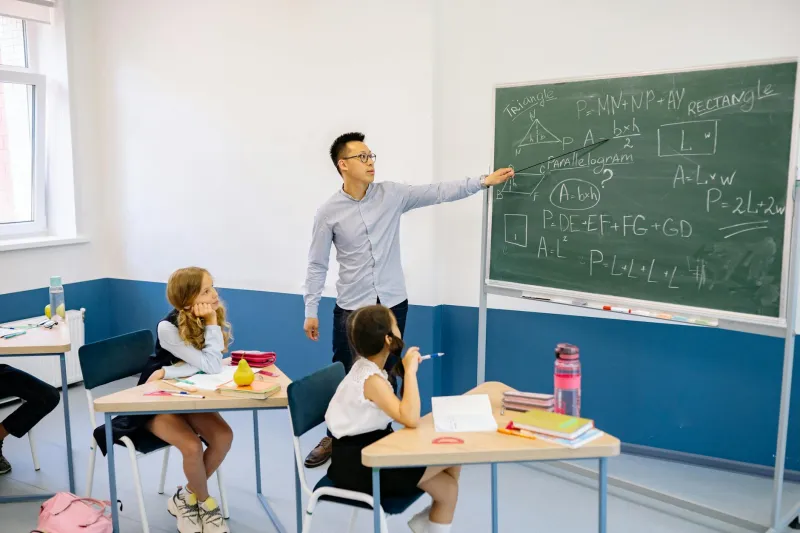
Step into an American classroom today, and the transformation is immediately obvious. Students sit in clusters around tables, working together on projects that might take weeks to complete. The teacher moves between groups, asking questions rather than providing answers, encouraging students to explain their thinking rather than simply demonstrate their recall.
Instead of memorizing historical dates, students analyze primary sources and debate different interpretations of events. Rather than drilling multiplication facts, they explore mathematical concepts through hands-on experiments and real-world problem-solving. English class might involve students writing and directing their own plays, creating podcasts, or analyzing contemporary social media trends.
Technology has fundamentally altered the learning landscape. Students carry devices more powerful than the computers that sent humans to the moon, giving them instant access to virtually all human knowledge. The teacher's role has evolved from information deliverer to learning facilitator—someone who helps students navigate, evaluate, and synthesize the overwhelming amount of information available to them.
The Skills That Matter Now
Today's educators focus on what they call "21st-century skills": critical thinking, creativity, collaboration, and communication. Students are encouraged to question sources, challenge assumptions, and develop their own informed opinions. Group work isn't just tolerated—it's essential preparation for a world where most meaningful work happens in teams.
The physical classroom itself tells the story of this transformation. Gone are the rigid rows of identical desks. Modern classrooms feature flexible seating arrangements, collaborative workspaces, and technology integration that would have seemed like science fiction to educators just two generations ago. Students might spend part of their day working independently on laptops, part in small group discussions, and part presenting their findings to the entire class.
Assessment has evolved too. Instead of relying solely on standardized tests that measure memorization, teachers use portfolio assessments, peer evaluations, and project-based learning that demonstrates deep understanding rather than surface recall.
What We Gained and What We Lost
This educational revolution has produced a generation of students who are more creative, more collaborative, and more comfortable with ambiguity than their grandparents. They're better prepared for a rapidly changing economy where the ability to learn new skills quickly matters more than mastering a fixed body of knowledge.
But some educators wonder if we've lost something valuable in the process. The old system, for all its flaws, did teach students to focus deeply, to respect expertise, and to master foundational skills through practice and repetition. There's growing debate about whether we've swung too far away from memorization and direct instruction, particularly in subjects like mathematics where procedural fluency remains important.
The transformation of American education reflects broader changes in how we think about authority, knowledge, and human potential. We've moved from a world where information was scarce and needed to be carefully preserved in human memory to one where information is abundant and the challenge is learning how to think about it wisely.
The classroom that never changed its mind has finally learned to embrace uncertainty, questions, and the revolutionary idea that students might have something valuable to contribute to their own education.