When the Mailbox Was Worth Walking To: The Slow Death of America's Daily Ritual
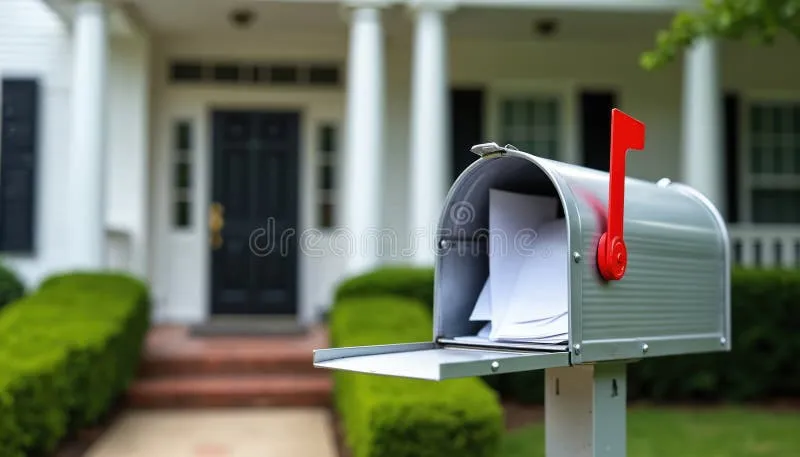
Photo: vintage American mailbox suburban home 1980s letter catalog delivery, via thumbs.dreamstime.com
Somewhere in the mid-1990s, before most Americans had email addresses, the daily trip to the mailbox was a minor but reliable event. You went out around the same time each afternoon. You sorted through the stack with a particular kind of attention — flipping envelopes, recognizing handwriting, noting return addresses. Some of what you found was mundane. Some of it mattered enormously. You never quite knew which until you looked.
That uncertainty was the point.
The Mailbox as Information Hub
For the better part of the twentieth century, the physical mailbox was the primary channel through which American households received information from the outside world. Bills arrived there. Bank statements arrived there. The Sears catalog — at its peak, a publication so thick it doubled as a booster seat — arrived there. Birthday cards, holiday greetings, college acceptance letters, jury summons, dividend checks, sweepstakes entries, and handwritten notes from people who still wrote handwritten notes all arrived through the same narrow slot.
For businesses, direct mail wasn't a supplementary marketing channel. It was often the primary one. Companies spent enormous resources designing mailers, segmenting mailing lists, and crafting offers they hoped would survive the journey from envelope to kitchen table. The direct mail industry in America peaked in the early 2000s at well over $40 billion annually. Catalog circulation was staggering — the U.S. Postal Service was delivering roughly 19 billion pieces of marketing mail per year at the height of the catalog era.
The economics made sense because the attention was there. People opened their mail. Not all of it, not always enthusiastically, but the physical act of handling an envelope created a moment of engagement that advertisers understood had real value. You had to make a decision about every piece. The digital inbox made ignoring things frictionless. The physical mailbox did not.
The Catalog Was Its Own Kind of Entertainment
It's easy to forget, in the era of infinite online browsing, what a major consumer touchpoint the printed catalog once was. The fall arrival of the Sears Wish Book was a genuine cultural event for American children — a thick, glossy object that got passed around the family and annotated with pen, dog-eared pages marking items of particular desire. JCPenney, Montgomery Ward, L.L. Bean, Land's End, J.Crew — each catalog had a distinct visual personality and a loyal readership that looked forward to its arrival the way people now look forward to a streaming release.
These weren't just shopping tools. They were aspirational objects. You could spend an afternoon with a catalog without buying anything, simply moving through a curated version of a life slightly better than your current one. The photography was studied. The copy was written to seduce. And because supply was finite — you got the catalog when it arrived, and then it was done until the next season — the browsing had a quality of scarcity that made it feel meaningful.
For rural Americans especially, the catalog was a lifeline. Before the internet connected small towns to national retail, a family in rural Kansas or western Montana had access to the same merchandise as a family in Chicago, delivered to the same mailbox, on roughly the same schedule. The catalog was one of the great equalizers of American consumer culture, and its decline removed something that had quietly served that function for generations.
What the Shift to Digital Actually Cost
The transition from physical to digital communication happened fast enough that its costs were largely invisible until after the fact. Email became standard in American workplaces through the late 1990s. Online bill pay followed. E-commerce eroded catalog culture. By the time social media and smartphones finished the job in the 2010s, the mailbox had become a repository for things no one wanted — credit card solicitations, political flyers, the occasional package slip.
For consumers, the obvious gains were speed and convenience. An email arrives in seconds. An online statement is available the moment it's generated. You don't have to wait for information that used to take days to travel across the country.
But the shift also atomized the experience of receiving communication. When everything arrives instantly and continuously, nothing arrives as an event. The anticipation that the daily mail run provided — the small, reliable interruption in the day, the physical sorting, the moment of recognition when you saw handwriting you knew — was replaced by a notification stream that never pauses and rarely surprises.
For businesses, the shift created new problems alongside the new opportunities. Email inboxes filled up and filters grew more aggressive. Open rates for marketing email have declined steadily for over a decade. The attention that physical mail commanded — imperfect, but genuine — proved harder to replicate in a medium where deletion requires a single tap.
There's an irony that some marketers have quietly discovered: direct mail, in 2024, actually gets opened at higher rates than marketing email. The mailbox is less crowded now. A well-designed piece of physical mail stands out precisely because it arrives in a space that used to be noisy and is now mostly empty.
The Weight of What Arrived
The personal letter deserves its own moment of recognition, because its disappearance represents something that no digital equivalent has fully replaced.
A handwritten letter required effort in a way that email fundamentally does not. The person who wrote it had to sit down, find paper, form thoughts into sentences without the ability to delete and retype indefinitely, address an envelope, find a stamp, and physically send the thing. That effort was embedded in the object itself. When you held a letter from someone, you held evidence of the time they'd chosen to spend on you.
Americans still send roughly 57 billion pieces of mail annually — but the vast majority is commercial or institutional. Personal letters have become so rare that receiving one now feels almost ceremonial. The medium that once carried the texture of daily relationships has retreated into special occasions: wedding invitations, condolence cards, thank-you notes from people who were raised to write them.
What the mailbox once held was a compressed version of your life's connections — financial, commercial, personal, civic — delivered in a single daily installment. The walk to retrieve it was brief and unremarkable. But it was also, in a way that's hard to fully articulate, a moment that confirmed you were part of something. That the world had sent something your way and was waiting to see what you'd do with it.
That walk doesn't mean much anymore. And the loss of it is quieter than most losses, which is perhaps why it took so long to notice.