Rubber Mats and Referees: How American Recess Stopped Being Wild and Started Being Managed
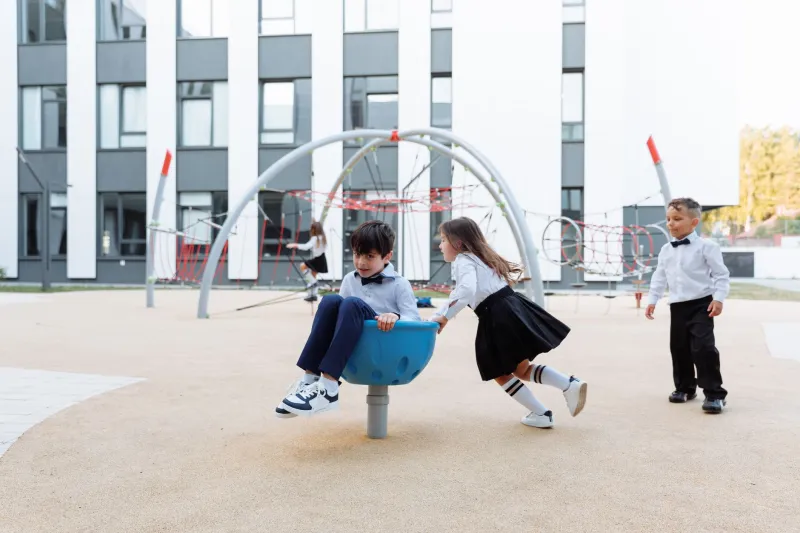
Somewhere in America right now, a group of elementary school kids is standing on a rubberized play surface under the watchful eye of two or three adult monitors, choosing from a short list of approved activities. Nobody is scaling a twelve-foot metal structure. Nobody is playing a game that hasn't been vetted for conflict potential. And the whole thing will wrap up in about fifteen minutes.
Half a century ago, that description would have been unrecognizable.
The Original Chaos
For most of the twentieth century, recess in American schools was genuinely unsupervised. A teacher might glance out the window occasionally, but the playground was largely a child-run territory. The equipment was brutal by modern standards — heavy steel jungle gyms bolted into concrete, merry-go-rounds that could fling a kid across the yard, metal slides that absorbed enough summer heat to brand a leg. The surface underneath was usually packed dirt, gravel, or plain asphalt.
And kids loved it.
The games were invented on the spot. Hierarchies formed and dissolved. Disputes got settled through negotiation, occasional shoving, and the kind of social pressure that only a peer group can apply. Nobody handed out the rules to four square — you learned them by watching, then by arguing about them, then by making up your own version when you controlled the square. Dodgeball was a contact sport with no apologies. Tag had no safe zones. Recess was, in the truest sense, unstructured time — and that structure-less quality was exactly the point.
The equipment sent kids to the nurse's office on a semi-regular basis. Scraped knees were a baseline condition of childhood. The occasional broken wrist was unfortunate but accepted. Parents didn't typically sue over a fall from the monkey bars. That was just what happened when you played hard.
The Liability Shift
The slow transformation of American recess didn't happen overnight. It crept in across several decades, driven by a combination of forces that each seemed reasonable on its own.
First came the lawsuits. As litigation culture expanded through the 1970s and 1980s, school districts began looking at their playgrounds as legal liabilities rather than learning environments. Metal equipment started disappearing, replaced by rounded plastic structures with weight limits and age recommendations stamped on the side. Rubber mulch and foam padding replaced asphalt. The Consumer Product Safety Commission issued guidelines for playground equipment that, while genuinely useful in some respects, gradually transformed the aesthetic of American playgrounds from industrial challenge courses into soft, color-coded obstacle parks.
 Photo: Consumer Product Safety Commission, via usercontent2.hubstatic.com
Then came the scheduling pressure. As standardized testing requirements expanded through the 1990s and accelerated dramatically after No Child Left Behind in 2001, schools began treating instructional minutes as a precious resource. Recess was easy to cut — it produced no measurable academic output. By the 2010s, some schools had reduced recess to a single fifteen-minute window. Others eliminated it almost entirely for older elementary grades.
And then came structured play. Well-meaning researchers and educators began advocating for "purposeful" recess, where children were guided toward activities with developmental goals. Trained play facilitators arrived on some playgrounds with equipment carts and organized games. The idea was to reduce bullying, include isolated kids, and maximize the developmental value of outdoor time. The result, unintentionally, was that free play started to look a lot like gym class with better weather.
What the Research Actually Says
Here's where things get complicated for the safety-first narrative. The research on unstructured play has been quietly building for decades, and it doesn't flatter the direction America chose.
Studies in developmental psychology consistently show that free, unstructured play is where children develop executive function — the ability to regulate their own behavior, manage frustration, negotiate with peers, and recover from social setbacks. When kids invent a game, they practice rule-making. When they argue about whether someone was out, they practice conflict resolution. When they fall off something and get back up, they recalibrate their sense of physical capability.
The American Academy of Pediatrics has issued repeated statements emphasizing that free play is not a luxury — it's a developmental necessity. Pediatric occupational therapists report seeing children who struggle with basic risk assessment, not because they're fragile, but because they were never allowed to test their limits in low-stakes environments.
 Photo: American Academy of Pediatrics, via www.surahyasen.com
Meanwhile, childhood anxiety rates have climbed steadily over the same period that recess shrank and playgrounds softened. That correlation doesn't prove causation, but it's hard to look at those two trend lines and feel entirely comfortable.
The Playground as a Mirror
What happened to American recess reflects something broader about how the country changed its relationship with childhood. The postwar generation of parents largely stayed out of their kids' unstructured time — partly out of necessity, partly out of philosophy. Children were expected to figure things out. Pain was instructional. Boredom was a precondition of imagination.
The generations that followed became progressively more involved. Partly that's a response to genuine changes in the world. Partly it's the product of an information environment that amplifies rare dangers into everyday fears. And partly it reflects a sincere, loving impulse to protect children from suffering.
But something got lost in the translation. The playground used to be the one place where kids operated on their own terms, solved their own problems, and discovered what they were physically and socially capable of. It was messy and occasionally bloody and completely irreplaceable.
Today's rubberized, monitored, fifteen-minute recess is safer by almost every measurable standard. It's also producing a generation that's never had the chance to find out what happens when no adult is watching.
That might be the most important thing we forgot to protect.