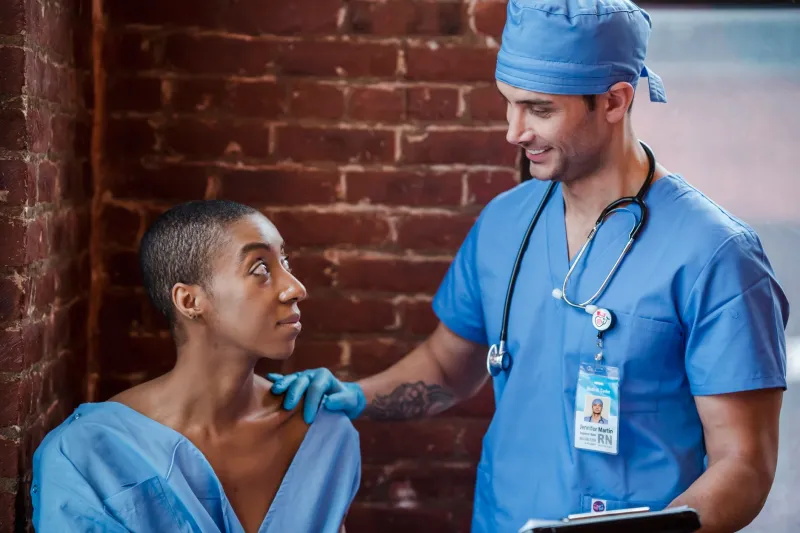
The Story You Told Was the Test: When Medicine Began With a Conversation

Photo by Photo by Vitaly Gariev on Unsplash on Unsplash
There's a particular kind of attention that feels different from being processed. You know it when you experience it — someone is actually listening, not just waiting for you to stop talking so they can type something. For most of American medical history, that kind of attention wasn't a luxury. It was the job.
The old family doctor didn't open your visit by pulling up a screen. He pulled up a chair.
The Art of the Long Appointment
Through much of the early and mid-twentieth century, a medical consultation in America was genuinely conversational. Physicians were trained — rigorously — in the art of taking a history. That meant asking open-ended questions, following the patient's language for clues, and building a picture of illness the way a detective builds a case: from fragments, impressions, and contradictions that eventually resolve into something coherent.
The physical examination that followed was similarly unhurried. Doctors percussed chests by tapping their fingers to listen for fluid. They pressed abdomens carefully, watching faces for the wince that told them more than the words. They looked at skin, eyes, and nails. They listened to breathing patterns with a quality of attention that took years to develop.
This wasn't nostalgia medicine. It was necessity. Diagnostic imaging was limited, laboratory tests were expensive and slow, and the tools available to a physician in a small-town practice were largely the ones he carried in his hands and his head. The patient's narrative wasn't just useful — it was often the only map available.
Research has consistently shown that a careful history alone can lead physicians to the correct diagnosis in roughly 70 to 80 percent of cases. The body, it turns out, is a reliable narrator. It just needs someone willing to sit still long enough to hear it out.
When Efficiency Entered the Exam Room
The transformation didn't happen overnight. It accumulated gradually, driven by forces that were individually reasonable but collectively disruptive.
Insurance reimbursement structures began rewarding procedures over conversations. A scan generates a billable code. A forty-minute discussion does not — or at least not one that reflects its actual diagnostic value. As healthcare systems grew larger and more industrialized through the latter half of the twentieth century, appointment slots shrank to match the math. Fifteen minutes became the standard unit of care at many practices. Some specialists run tighter than that.
Electronic health records, introduced broadly in the 2000s and accelerated by federal incentives after 2009, were designed to improve care coordination and reduce error. They largely succeeded on those terms. But they also introduced a third presence into the exam room: the screen. Studies tracking physician behavior found that doctors now spend roughly half of their patient-facing time entering data. Eye contact dropped. The patient became, in a quiet but meaningful way, secondary to the documentation of the patient.
And then came imaging. CT scans, MRIs, and ultrasound became so accessible and so trusted that the physical examination began a slow retreat. Why palpate an abdomen for twenty careful minutes when a scan can show you the same information in higher resolution? The logic is not wrong. The image often knows more than the hand. But something was lost in the trade.
What the Conversation Actually Did
Here's what tends to get overlooked in the efficiency argument: the diagnostic conversation did more than gather data. It was also, quietly, therapeutic.
Patients who felt heard reported better outcomes — not just higher satisfaction scores, but measurable improvements in adherence, recovery, and even pain tolerance. The act of articulating your symptoms to an attentive listener helped patients organize their own understanding of what was wrong with them. It gave them agency in the process. It also, not incidentally, built the kind of trust that made patients more likely to return, more likely to be honest, and more likely to follow through on treatment.
The old-style physician also caught things that algorithms miss. The patient who came in for a knee complaint but mentioned, almost as an aside, that she'd been feeling unusually tired. The man who described his heartburn with a particular urgency that didn't match the symptom itself. Experienced clinicians learned to listen for what was said at the edge of the conversation — the thing the patient mentioned because they were embarrassed to lead with it, or because they didn't think it was related, or because they needed to trust you before they handed it over.
That kind of listening requires time. Time is what modern medicine has least of.
What We Gained, What We Traded
It would be dishonest to romanticize the old way without acknowledging what it missed. Pre-imaging medicine also meant undetected cancers, misread symptoms, and confident diagnoses that turned out to be spectacularly wrong. The physician's intuition was powerful, but it was also fallible in ways that modern diagnostics have corrected. People are alive today because a scan caught something a conversation would have missed.
The gains are real. The question is whether they required abandoning the conversation entirely, or whether the two could coexist.
Some practices are trying to find out. The slow medicine movement, concierge primary care, and a growing number of physician-led reform efforts are pushing back against the fifteen-minute standard. They argue — with evidence — that longer appointments reduce downstream costs by catching problems earlier and improving compliance. That the conversation isn't inefficient. It's actually the most efficient tool available, if you're willing to give it the time it needs.
For now, most Americans experience healthcare as a series of brief, transactional encounters with providers who are genuinely trying but structurally constrained. The doctor often wants to listen. The system doesn't give her the hour to do it.
Somewhere in that gap between intention and structure is the medicine we used to have — and the version of care we're still figuring out how to build back.