Twenty-Four Exposures: When a Photograph Was a Promise You Made to the Moment
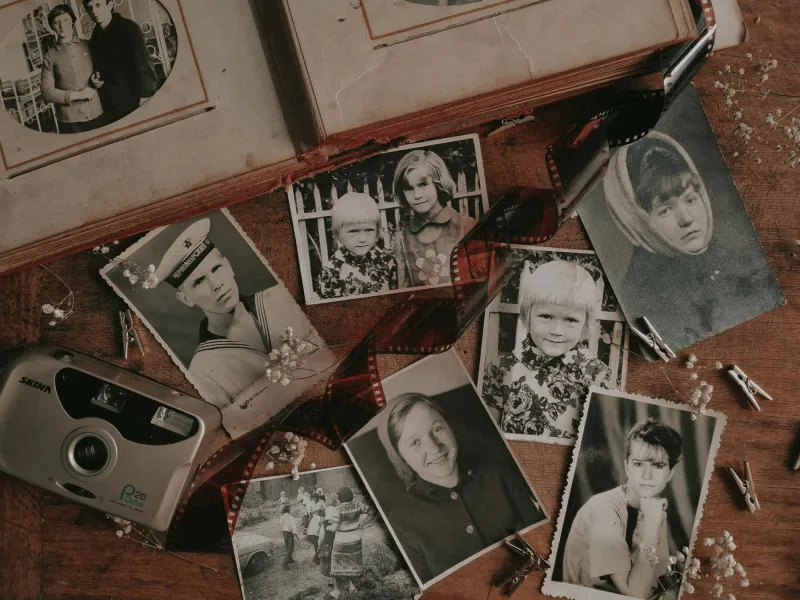
Somewhere in a closet or a cardboard box in a lot of American homes, there's an album. Maybe it's covered in faded fabric or cracked vinyl. Maybe the photos are held in place by those little adhesive corners that always gave up eventually. But the pictures inside — the slightly blurry Christmas mornings, the stiff family portraits, the vacation shots where someone's always squinting into the sun — those pictures meant something. They were chosen.
Choosing is the part we lost.
The Weight of a Single Frame
Before digital photography rewired our relationship with images, taking a picture required a small act of commitment. You loaded a roll of film — twenty-four or thirty-six exposures, depending on how optimistic you were feeling — and that was your budget. Not a metaphorical budget. An actual, physical, finite number of moments you could capture before the roll ran out.
You thought before you pressed the shutter. Is this worth one of my twenty-four? Is the light right? Is everyone looking? If your nephew was mid-sneeze or your wife had her eyes closed, you didn't shoot again automatically. You made a judgment call.
And when the roll was finished, you didn't see the results for days or weeks. You dropped the canister at the drugstore, picked up a numbered ticket, and came back later. The waiting was its own ritual — a small, low-grade anticipation that made the reveal feel like something. When you finally spread those prints across the kitchen table, you were experiencing those moments for the second time, and the gap between then and now gave them a kind of weight.
The Economy of Scarcity
Film photography operated on scarcity, and scarcity creates value. A family that shot two or three rolls a year — at holidays, vacations, graduations, and the occasional ordinary Sunday that felt worth preserving — was building an archive that represented actual decisions. Every image in that album passed a filter: someone thought this moment was worth a slot.
The physicality mattered too. Prints could be held, shared, written on, mailed across the country to a grandmother who didn't travel anymore. They could be damaged, which made preservation a genuine act of care. People put photos in albums because albums protected them. The act of organizing a photo collection was a form of curation — a second pass at deciding what mattered.
Many families treated good photographs the way they treated other heirlooms. A well-composed portrait from the 1960s might hang on a wall for forty years. The image had permanence because the object had permanence.
The Flood That Followed the Click
The shift from film to digital didn't happen in a single moment, but the early 2000s were when it became irreversible for most American households. Digital cameras dropped in price, storage cards expanded, and the constraint vanished. Suddenly there was no reason not to shoot. So everyone shot everything.
And then the smartphone finished the job.
The average American now takes somewhere in the range of a thousand photographs a year — some estimates run much higher. The phone is always present, always ready, and the cost of any individual shot is effectively zero. Shoot ten versions of the same moment and delete nine of them. Or don't delete anything. Storage is cheap. Space is infinite. Nothing has to be chosen.
The result is a paradox that anyone with a full camera roll has felt without quite naming it: we have more photographs of our lives than any generation in history, and somehow it feels like we're remembering less.
When Everything Is Saved, Nothing Gets Kept
There's a concept in psychology sometimes called "cognitive offloading" — the tendency to stop memorizing things that are externally recorded. We don't remember phone numbers anymore because our phones hold them. And increasingly, we don't fully experience moments because we're busy documenting them, trusting the image to carry the memory so our brains don't have to.
But the images don't actually carry the memory if nobody ever looks at them again. And most of us don't. Studies on digital photo habits consistently find that the vast majority of images taken on smartphones are never revisited. They sit in a camera roll that scrolls back years, largely unseen, forming a kind of visual landfill.
The intentional photo album — curated, printed, organized — has become a niche hobby rather than a standard household practice. Photo books can be ordered online, and some families still do it. But the impulse to print and preserve has faded alongside the sense that any individual image is precious enough to deserve it.
The Instagram Effect and the Performance of Memory
Social media added another layer to the transformation. Photographs stopped being purely about preservation and became about broadcast. The question shifted from "will I want to remember this?" to "will other people want to see this?" The composition of a shot now factors in likes and engagement in ways that have nothing to do with the actual memory being made.
The food gets photographed before it gets eaten. The sunset gets captured before it gets watched. The child's birthday moment gets recorded so thoroughly that the parent experiences it primarily through a four-inch screen. The documentation and the experience have swapped places, and it's not always clear which one we think is real.
What Those Twenty-Four Frames Taught Us
There's something to be said for constraint. The finite roll of film forced a kind of attention — a looking before shooting, a presence before recording. When you knew you had eight frames left and two weeks until vacation ended, you thought harder about what the trip had actually meant. You looked for the image that captured it.
That discipline produced photographs that people have kept for sixty years. It produced albums that children inherit and spend afternoons going through. It produced a relationship between image and memory that felt mutual — the picture reminded you of the moment because you'd been fully in the moment when you took it.
We have better cameras now, by every technical measure. We have more images, more storage, more sharing capability, more everything.
We just have fewer reasons to look at any of it.