When School Was a Family Affair: The Era of Kitchen Table Conferences and Front Porch Report Cards
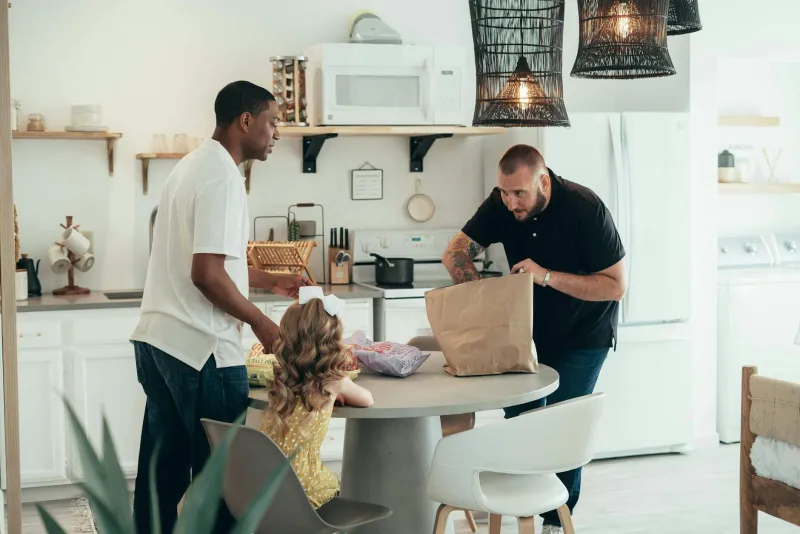
Picture this: It's 1955, and Mrs. Henderson finishes her teaching day at Lincoln Elementary, but instead of heading home, she walks three blocks to visit the Murphy family. Tommy Murphy has been struggling with his multiplication tables, and Mrs. Henderson wants to show his mother some techniques they can practice together. She'll stay for coffee, ask about Tommy's older sister who graduated last year, and leave behind a stack of books she thinks the family might enjoy.
 Photo: Murphy family, via techtimes.dexerials.jp
 Photo: Mrs. Henderson, via thewedge.com.au
 Photo: Lincoln Elementary, via i.pinimg.com
This wasn't an exceptional evening—it was how American education worked for most of the 20th century. Teachers and families weren't separated by institutional barriers, online portals, and scheduled conferences. They were neighbors, community members, and partners in a shared project of raising children.
The Teacher Who Lived Down the Street
In mid-century America, teachers were often pillars of their local communities. They shopped at the same grocery stores as their students' families, attended the same churches, and lived in the same neighborhoods. This wasn't accidental—many school districts actively recruited teachers who would become invested community members.
Teachers knew their students' families in ways that would seem impossible today. They understood which fathers worked night shifts and might need homework accommodations, which mothers were struggling with new babies, and which grandparents were helping with childcare. This knowledge shaped everything from classroom discipline to homework assignments.
The relationship worked both ways. Parents knew their children's teachers as real people with their own families, challenges, and personalities. Mrs. Johnson wasn't just "the third-grade teacher"—she was the woman whose husband worked at the mill, whose own children attended the high school across town, and who grew the best tomatoes in the neighborhood.
Home Visits as Standard Practice
What seems extraordinary today was routine then: teachers regularly visited their students' homes. These weren't crisis interventions or disciplinary meetings—they were relationship-building visits designed to strengthen the connection between school and family.
During these visits, teachers gained crucial insights into their students' lives. They saw the family dynamics, the home learning environment, and the resources available for supporting education. A teacher might discover that little Sarah was tired in class because she shared a bedroom with three siblings, or that Michael's math struggles stemmed from his need for glasses his family couldn't afford.
These home visits also allowed teachers to share educational strategies directly with parents. Instead of sending home generic study tips, teachers could demonstrate specific techniques in the family's own environment, using materials the family actually had available.
The Extended Family of Education
The institutional memory in these schools was remarkable. Teachers often taught multiple children from the same family over the years, sometimes spanning decades. A veteran teacher might have taught a student's parent, aunt, and older siblings, creating an educational relationship that transcended individual classroom experiences.
This continuity meant that teachers understood family patterns, learning styles, and challenges in ways that informed their approach to each new student. They knew that the Johnson children all struggled with reading but excelled in math, or that kids from the Martinez family needed extra encouragement but would thrive once they gained confidence.
Schools maintained detailed records not just of academic performance, but of family circumstances, health concerns, and social factors that might affect learning. These weren't invasion of privacy—they were tools for providing better, more personalized education.
The Gradebook Revolution
The shift away from this intimate educational model didn't happen overnight. It began in the 1970s and accelerated through the following decades as schools grew larger, teacher mobility increased, and families became more geographically scattered.
Technology played a major role in this transformation. When gradebooks moved online and parent communication shifted to email and educational software, something fundamental changed. The casual, ongoing conversations that once happened at the grocery store or church were replaced by formal, scheduled interactions.
Parent-teacher conferences became institutionalized events rather than natural extensions of community relationships. Instead of Mrs. Henderson stopping by the Murphy house when she noticed Tommy struggling, communication became channeled through official appointments, progress reports, and digital platforms.
What We Gained and Lost
Modern educational systems offer undeniable advantages. Online gradebooks give parents real-time access to their children's academic progress. Email allows for more efficient communication between busy families and teachers. Standardized procedures ensure that all families receive equal access to information and resources.
Professional boundaries, while sometimes creating distance, also protect both teachers and families from potential conflicts of interest or inappropriate relationships. The formalization of school-home communication has eliminated some of the informal favoritism that could arise when teachers had closer relationships with some families than others.
But the losses are significant too. Today's teachers often know remarkably little about their students' home lives, family circumstances, or community contexts. They may teach 150 students per day across multiple schools, making the kind of deep, sustained relationships that once defined education nearly impossible.
The Digital Divide in Educational Relationships
Modern communication tools, while efficient, have created new barriers between schools and families. Parents who aren't comfortable with technology, who work multiple jobs, or who don't speak English as their first language often find themselves cut off from their children's educational experience in ways that wouldn't have happened when teachers lived in the same neighborhoods.
The online portals that were supposed to increase parent involvement have sometimes had the opposite effect, creating a sense that education is something that happens "over there" in the school building rather than something that involves the entire community.
The Community We Built Around Learning
The era of intimate school-community connections wasn't perfect. It could be intrusive, limiting, and sometimes played favorites based on social connections rather than educational need. But it also created something powerful: a shared sense that educating children was a community responsibility, not just an institutional service.
When teachers knew families personally, education became a collaborative project. Parents weren't customers receiving a service—they were partners in a shared endeavor. Children saw that their teachers cared about them not just as students but as whole human beings embedded in families and communities.
The front porch conversations, kitchen table conferences, and chance encounters at the hardware store created an educational ecosystem where learning happened everywhere, not just during official school hours.
Rebuilding Connection in a Digital Age
As American education grapples with challenges from declining achievement to increased mental health concerns among students, some educators are working to rebuild the community connections that once made schools integral parts of neighborhood life.
Some schools are experimenting with "community teacher" models, where educators spend part of their time in neighborhood settings rather than just in classrooms. Others are creating family engagement programs that go beyond traditional parent-teacher conferences to rebuild the kind of ongoing relationships that once happened naturally.
The challenge is finding ways to recreate the benefits of intimate school-community connections while respecting modern realities of family privacy, professional boundaries, and diverse community needs.
The teachers who once knocked on front doors with report cards in hand understood something we're still trying to recapture: that education works best when it's not just about moving information from teacher to student, but about building relationships that support learning in every corner of a child's life. In our rush to modernize and systematize education, we may have optimized away some of the very human connections that made learning possible in the first place.