Before Siri Spoke, America Got Beautifully Lost: The End of Discovery on the Open Road
The Last Great Adventure in Your Driveway
In the summer of 1985, planning a cross-country road trip meant spreading a massive paper map across your kitchen table, tracing routes with your finger, and accepting that you'd probably spend at least part of your journey completely, wonderfully lost. This wasn't a bug in the system — it was the feature that made American road trips magical.
Today, that same journey requires little more than typing a destination into your phone and following the blue line. We've gained efficiency and lost mystery, traded adventure for optimization, and replaced discovery with algorithmic certainty.
The Ritual of the Paper Map
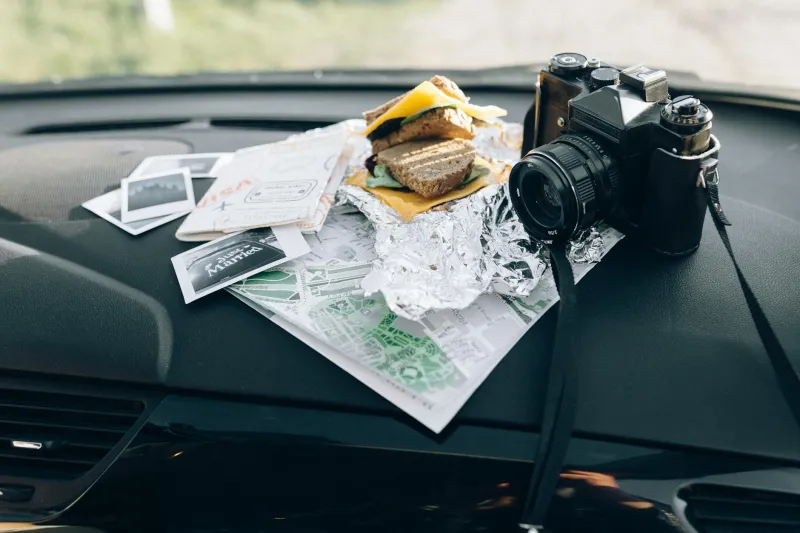
Before GPS, every road trip began with cartography. Families would gather around dining room tables covered in AAA TripTiks, Rand McNally atlases, and state highway maps picked up from rest stops and gas stations. These weren't just navigation tools — they were invitations to dream.
The maps told stories. Red lines indicated major highways, perfect for making time. Blue lines marked scenic routes that might add hours to your journey but promised views worth the delay. Green areas suggested national parks and forests where adventure waited off the beaten path.
Planning a route meant making choices. Should you take I-80 straight across Nebraska for speed, or meander through the back roads to see what small-town America looked like? These decisions shaped not just your travel time, but the entire character of your trip.
The Art of Getting Directions
When you inevitably strayed from your planned route — and you always did — finding your way back required human interaction. You'd pull into a gas station, unfold your map on the counter, and ask the attendant how to get to wherever you were trying to go.
These conversations were miniature cultural exchanges. The local might warn you about construction on Highway 50, recommend a diner just off your route, or suggest a scenic detour that "only adds about twenty minutes but shows you the prettiest valley in three counties." Some would grab a napkin and sketch out directions, complete with landmarks: "Turn left at the red barn, go about five miles until you see the water tower, then hang a right."
These directions often came with stories. The red barn belonged to the Johnson family, who'd been farming that land since 1923. The water tower was painted by high school students as a graduation project in 1967. What started as simple navigation became local history lessons from strangers who became temporary guides.
The Beautiful Accident of Discovery
Getting lost wasn't just inevitable — it was often the best part of the trip. A wrong turn might lead you to a roadside dinosaur sculpture, a family-run pie shop, or a scenic overlook that no guidebook mentioned. These accidental discoveries became the stories you'd tell for years afterward.
The uncertainty created a different kind of awareness. Without a GPS voice telling you exactly when to turn, you had to pay attention to your surroundings. You noticed landmarks, read signs, and developed an intuitive sense of direction. The landscape became part of your navigation system rather than just scenery scrolling past your window.
This attention to place created deeper memories. When you had to work to understand where you were, you remembered it better. The town with the giant ball of twine wasn't just a GPS coordinate — it was the place you found after taking that confusing exit near the grain elevator, where the friendly woman at the gas station drew you a map on the back of a receipt.
The Death of Serendipity
GPS technology began appearing in consumer cars in the late 1990s, but it didn't become ubiquitous until smartphones made turn-by-turn navigation available to everyone. The transformation was remarkably swift. By 2010, the paper map industry had largely collapsed, and getting lost had become an anachronism rather than an adventure.
Modern navigation systems are marvels of efficiency. They calculate optimal routes in real-time, adjust for traffic conditions, and can guide you to any address in America with remarkable precision. But this efficiency comes at a cost: the death of serendipity.
Today's GPS doesn't recommend the quirky roadside attraction or the local diner beloved by truckers. It optimizes for time and distance, not wonder or discovery. The algorithm doesn't know that taking the scenic route through Colorado's back roads will show you aspen groves that glow like gold in September sunlight.
The Homogenization of the American Road Trip
GPS navigation has created what researchers call "algorithmic tourism" — travel patterns determined by software rather than curiosity. When millions of travelers follow the same optimized routes, they encounter the same chain restaurants, stay at the same hotel brands, and miss the unique local businesses that once defined American road culture.
The interstate highway system, built in the 1950s and 1960s, already began this homogenization process. But GPS has accelerated it by funneling even more traffic onto the most efficient routes while abandoning the back roads where authentic America still exists.
Small towns that once thrived on through traffic from lost or adventurous travelers now watch cars stream past on distant highways, guided by voices that never suggest stopping to see what makes each place special.
What We've Lost in Translation
The shift from paper maps to GPS represents more than just technological progress — it's a fundamental change in how we relate to space, place, and discovery. We've gained the ability to reach any destination efficiently, but we've lost the capacity to be surprised by the journey.
Modern travelers often arrive at their destinations without any real sense of the geography they've crossed or the communities they've passed through. The journey becomes a series of turns dictated by a disembodied voice rather than a voyage of discovery through America's diverse landscapes and cultures.
Younger generations have never experienced the particular anxiety and excitement of being genuinely lost — that moment when you realize you're not entirely sure where you are, but you're confident you'll figure it out. They've never felt the satisfaction of navigating by landmarks and intuition, or the joy of discovering something wonderful that wasn't on any planned itinerary.
The Persistence of Paper
Despite GPS ubiquity, a small but dedicated community of travelers still swears by paper maps. They argue that physical maps provide context that screens can't match — the ability to see the big picture, understand regional geography, and spot interesting detours that GPS might never suggest.
Some national parks and wilderness areas still recommend paper maps as backup navigation, recognizing that GPS signals can fail and batteries can die. In these places, the old skills of map reading and compass navigation remain not just useful but essential.
Digital Detours and Modern Discovery
Interestingly, some travelers are using technology to recreate the randomness that GPS eliminated. Apps like Roadtrippers suggest interesting stops along your route, while others generate random destinations for weekend adventures. These digital tools attempt to restore serendipity to travel, though they can't fully replicate the organic discoveries that came from genuine uncertainty.
Social media has also created new forms of travel discovery, as Instagram posts and travel blogs highlight hidden gems and off-the-beaten-path destinations. But these curated recommendations lack the personal surprise of stumbling upon something unexpected while genuinely lost.
The Price of Never Being Lost
GPS has undoubtedly made travel safer and more efficient. Families no longer spend hours driving in circles, searching for their hotel or campground. Emergency services can locate stranded travelers with unprecedented accuracy. The technology has genuine benefits that shouldn't be dismissed.
But we've also lost something irreplaceable: the knowledge that comes from paying attention to place, the confidence that develops from navigating by observation and intuition, and the joy of discovering America's hidden treasures through beautiful accidents rather than algorithmic recommendations.
In our rush to optimize every journey, we may have forgotten that sometimes the best destinations are the ones we never planned to find — the places we discovered not because a computer told us to go there, but because we took a wrong turn, asked a stranger for directions, and found ourselves somewhere wonderful that we never knew existed.
The GPS voice may never lead us astray, but it also may never lead us to wonder. And in a country as vast and varied as America, that might be the greatest loss of all.