The Chair, the Clippers, and the Conversation America Stopped Having
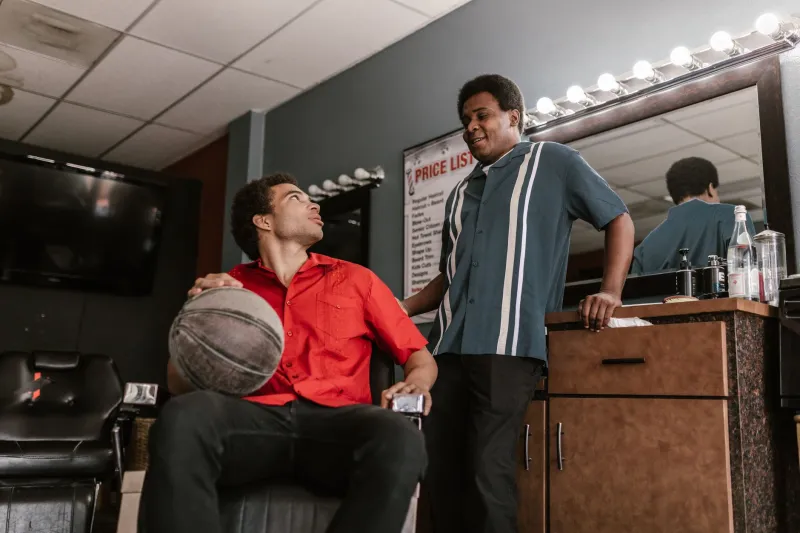
Walk into a traditional American barbershop in 1963 and you'd encounter something that doesn't have a modern equivalent. Not just a place to get a haircut — a place to find out what was actually happening. Who was running for city council and why they probably shouldn't be. Whose son had just come home from the service. Which factory was laying off workers. What the guy three chairs down thought about the new highway they were planning to run through the east side of town.
The barbershop was America's original talking room. Long before social media gave everyone a platform and nobody an audience, the neighborhood barbershop was where local information moved, where opinions were tested against real people with real stakes in the outcome, and where the simple act of waiting your turn meant sitting inside a living current of community life.
That world is largely gone now. And the way it disappeared tells you something worth paying attention to.
More Than a Haircut
The traditional barbershop occupied a specific social niche that's difficult to categorize by modern standards. It wasn't quite a business in the transactional sense we'd recognize today. It was more like a public institution that happened to charge for a service.
The barber himself — and it was almost always a man, in the classic American tradition — was a particular kind of figure. He was a skilled tradesman, yes, but also a keeper of local knowledge. He knew who was hiring and who was struggling. He'd heard the real story behind the divorce that everyone was talking about. He had opinions about the mayor and wasn't shy about sharing them, but he also knew how to keep a confidence when keeping it mattered.
Regular customers didn't just show up for a trim. They showed up for the room. The waiting area was its own ecosystem — a stack of magazines nobody was really reading, a few chairs occupied by men who weren't necessarily in a hurry to get to the front of the line, a radio playing in the background that could be argued with or agreed with as the mood dictated. Time moved differently in there. It was one of the few places in American life where sitting still and talking to strangers was not just acceptable but expected.
The News That Traveled by Mouth
Before the internet made information instantaneous and infinite, local news traveled through social networks that were physical and personal. The barbershop was a primary node in that network. Information arrived with the customers and circulated with the conversation.
This wasn't gossip in the dismissive sense — or at least, it wasn't only gossip. It was civic intelligence. People learned which roads were being repaired, which school board members were causing trouble, which businesses were in trouble, which new families had moved into the neighborhood. They learned it from people who had direct knowledge and a direct stake in the outcome.
The conversations that happened in barbershops were also politically real in ways that online debate rarely manages to be. When you disagree with someone sitting three feet away from you, someone whose name you know and whose kid goes to school with your kid, the disagreement has weight. You can't log off. You have to find a way to continue existing in the same community as this person after the argument is over. That constraint produced a kind of conversational discipline that anonymous digital spaces have largely eliminated.
Black barbershops, in particular, served a function that went beyond civic information exchange. In communities where other public spaces were segregated or hostile, the barbershop was a sanctuary — a place where Black men could speak freely, organize politically, and maintain cultural identity under enormous external pressure. The role that Black barbershops played in civil rights organizing and community resilience is a chapter of American history that deserves far more attention than it typically receives.
How the Room Got Quiet
The forces that eroded the traditional barbershop culture were numerous and arrived from different directions.
The rise of unisex salons in the 1970s and 1980s changed the social architecture of hair care. When men and women shared the same space, the dynamics shifted — conversations became more careful, the specific male social ritual of the traditional shop began to dissolve. Franchise chains brought standardization and efficiency but stripped away the idiosyncratic personality that made individual shops irreplaceable.
Suburbanization scattered communities that had once been walkably dense. The neighborhood barbershop that served a tight geographic area became harder to sustain when the neighborhood itself became a collection of people who drove in from different directions and didn't particularly know each other.
And then came the smartphone. The device that made it possible to be anywhere while being mentally somewhere else fundamentally altered the experience of waiting. People who once sat in a barbershop and talked because there was nothing else to do now sit in the same chair staring at a screen, plugged into headphones, physically present but socially absent. The waiting room — once the heart of the institution — became a holding area.
App-based booking systems optimized the experience further. You arrive at your scheduled time, minimize your wait, get your cut, pay through an app, and leave. Efficient. Frictionless. And almost entirely without the texture that made the old version worth remembering.
What the Empty Chair Reveals
The decline of the barbershop as a social institution isn't an isolated phenomenon. It's part of a broader pattern — the retreat from unstructured public time, from spaces where conversation happens without an agenda, from the kind of slow, inefficient community contact that turns strangers into neighbors.
We've replaced those spaces with digital alternatives that promise connection and deliver something thinner. Social media gives you access to millions of opinions and almost no genuine dialogue. You can follow the news from a thousand sources and still have no idea what's actually happening on your own block.
Some traditional barbershops are holding on — and in certain communities, particularly Black neighborhoods where the institution never fully lost its cultural weight, they're thriving. There's even a quiet revival among younger men who've discovered that a slow Saturday morning in a real barbershop, with real conversation and no particular schedule, is something worth seeking out.
They're finding what their grandfathers never had to look for. The chair was always there. The conversation was always happening. You just had to show up and sit down.